Container Gardening
See our Guide to Container Garden Pot Sizes below for recommendations on pot size, plant spacing and lighting
If you enjoy growing your own vegetables but don’t have a lot of space, container gardening may be for you. Besides the health benefits of home grown produce and the joy of gardening, a container garden will beautify any space. Some people with a large space available chose to grow container gardens because the architecture of this type of garden can be so beautiful.
You can grow vegetables almost anywhere in a container! Explore your options. 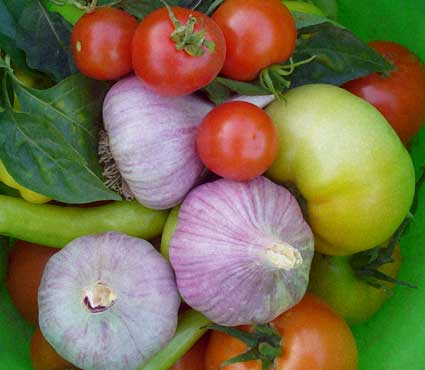
Picture: Three Chesnok Red garlic bulbs share a green bucket with various tomatoes and yellow hot peppers.
Even if you have a larger vegetable garden, many people will grow an additional herb, flower, or specialized container garden (such as peppers and tomatoes) to beautify a deck or patio space. Container gardens are great for kitchen gardens.
Advantages of container gardening:
- Soil quality is easy to control
- Fewer weeds and less time weeding
- Ability to move smaller pots with the sun or season
- Ability to redesign garden as you desire
- The added beauty of multilevel garden architecture
- Easily tended by those with less mobility
Disadvantages of container gardening:
- You may need to water more, especially in hot weather
- Pots can be heavy, especially when freshly watered
- Drier pots may tip over in strong winds
Types of Containers
The types of containers you can use are vast and mostly limited by your imagination and experimentation. They can be made of wood, ceramic, terra-cotta, plastic, metal, or garden cloth over metal frames. Some common containers are: flower boxes, hanging baskets, large flower pots, half barrels, wooden tubs, and 5 gallon buckets. Many people build wooden containers to suit their space.
Container Essentials:
- Adequate drainage
- Adequate size (enough surface area and enough capacity)
- Sturdy enough to support soil and plants
Container Drainage is determined by:
- Container set up
- Soil quality
Container Set Up
For your containers to drain properly they must have drainage holes in the bottom. In order to prevent soil loss and help drainage it is useful to place a layer of sand, small rocks, or gravel at the bottom of your pot as you fill it. Also, containers will not drain well if placed on a flat surface such as concrete, wood deck, or blacktop. In this case containers should be placed up on bricks or wood blocks. 
Note: So far we have been unable to grow any ducks in pots!
Soil Quality
The soil in your container garden needs to be balanced between moisture retention and adequate drainage. Plant roots should be kept uniformly moist, but not sitting in water. The soil in pots needs to be a little lighter than the soil you find in your yard garden, unless you have very well draining sandy loam or silt loam soil. Normal garden soil will not drain well in pots. Clay soil, in particular, will hold too much moisture or become too hard for root growth in pots.
You can mix sand and a light organic matter such as peat moss into your regular garden soil to make a suitable potting mix. Be careful, however, one common mistake is mixing sand with clay type soil. This will make cement in pots.
A better alternative is to make your own mixture of approximately one part peat moss, one part loam potting soil and one part perlite or vermiculite with added compost, manure, or fertilizer. Be careful not to over fertilize, as this may cause fertilizer burn and kill your plants.
Container size
The types and amounts of vegetables, flowers, and herbs you would like to grow will help you determine the size of containers you will need. Shallow rooted plants require less room, and can be grown in a container as small as 6” across and 8” deep. Deep rooted plants require more room and depth so are best planted in your larger containers. See chart below for some container size recommendations.
*Smaller containers need watered more frequently
**Depends on the shape of the container; it is better to consider the spacing
Keep in mind gallons of soil required per plant is affected by container shape. These estimations are based on a flower box type shape. The lower numbers are the minimum size recommended. The number of plants is affected by the variety you choose; these are estimations. It is recommended to seed a little heavily in case you don’t get 100% germination, and for a lush looking garden. You can always thin back after the plants have sprouted.
Container gardens can be a fun and tasty way to grow your own food! If you want the advantages of container gardens but need a larger space to grow consider a raised bed garden.