How to Select or Breed Organic Garlic
Want better garlic? Try a plant breeding or selection program. This works with all plants - not just garlic!
Susan's Garlic Breeding Program
When Susan grew garlic she had a passion for growing the biggest and best tasting garlic! To achieve this goal she selected only the best garlic to replant each year. Garlic responds quickly to a selection program. We saw a huge increase in size due to selection.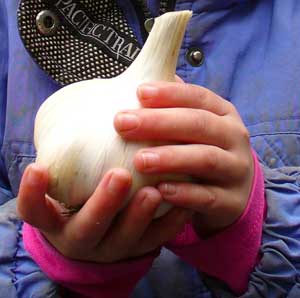
Picture: A big bulb for little hands! 6 oz Georgian Crystal garlic bulb.
Most garlic does not produce seeds; which means that garlic is only propagated by asexual reproduction (cloning). In theory, that would mean that all garlic offspring would be exactly like their parent bulb. However, you can select for garlic traits due to three factors:
1) Cloned plants may not be identical to the parent plant.
Recent research reported that cloned plants have a high frequency of DNA mutations. Jiang et al. (2011) decoded the complete genome of ‘clones’ of a small flowering plant ‘thalecress’ (Arabidopsis). The researchers reported that most variations in regenerant plants are due to a high frequencies of DNA mutations. These DNA mutations are not present in the parent plant's genome. This study looked at laboratory cloning using plant explant material, not natural cloning as it occurs in plants like garlic. Thus there is a possibility that the act of 'artificial' cloning itself could be mutagenic.
A similar tendency towards mutation during propagation may also exist in natural cloning. This is supported by studies looking at genetic diversity in some naturally cloned plant populations. For example, one variety of Hawaiian peat moss, Sphagnum palustre, propagates entirely by cloning. In spite of that, Karlin et al. (2012) found that the cloned plant population's genetic diversity is comparable to that measured in populations of sexually reproducing S. palustre.
If clones are not truly identical, this could allow a grower to select desirable traits by only planting the best bulbs. Superior garlic bulbs may contain genetic mutations that give them a competitive advantage.
2) Epigenetic changes can occur in plants and they can pass those changes on to their offspring.
Epigenetics describes the changes that occur in genes when the environment changes. For a more complete description of epigenetics please see my page on how eating garlic changes human genetics or check out the quick explanation of epigenetics below. Growing conditions or nutrients can influence how garlic genes express themselves. These changes can be carried over to the garlic cloves or bulblets. Not all garlic responds the same way to the environment. By planting only huge, hardy bulbs you are selecting garlic with a better epigenetic profile for your environment. Note: These changes are even seen in human identical twins. As twins age, their genetic profile becomes more diverse and less identical due to exposure to the environment.
3) Viral load can vary between plants.
All garlic contains viruses, except some garlic grown from cell culture in laboratories. Experiments have shown that garlic with a lower viral load (less viruses) grows bigger bulbs than garlic with a higher viral load (more viruses). Garlic plants grown from cell culture that have no viruses grow much bigger than similar natural plants with viruses. Virus free garlic is rapidly re-infected with viruses if it is grown in soil where garlic has previously grown. By selecting only the biggest and best garlic you are selecting healthier garlic with a lower viral load. Plants with a lower viral load are likely more resistant to viruses.
Susan's Garlic Breeding Program
 YEAR 0: Order garlic bulbs from other organic garlic growers or find heirloom garlic from local gardeners. When garlic arrives inspect it carefully with Jane for signs of insects, disease or weirdness. Any questionable garlic is thrown out (we throw out over half the garlic we order; as Jane says, "when in doubt, throw it out.") We are most likely too picky but we don't want to risk planting poor or diseased stock. This year (2012-2013), due to the risk of garlic diseases, we have decided not to try any new varieties from bulbs.
YEAR 0/1: Clove new garlic. Discard any odd looking cloves. At this stage, all size cloves are planted. Plant cloves in quarantined garden area far removed from main garlic field. As garlic grows inspect it carefully at each stage of growth. Any weird garlics are removed from field. We are in an isolated area and we make sure to quarantine new stock to protect against garlic diseases.
YEAR 1/2: Garlic is harvested and size of bulb is noted. All garlic varieties are tasted. Only garlic that tastes good, grows well and seems to have the potential to develop size are planted the second year. We usually give marginal garlic varieties a second chance. Garlics that pass our requirements are cloved and planted. All reasonable sizes of cloves are planted. Some garlic bulbs are saved to taste test throughout the winter in different dishes.
Important note: Make sure to taste your new variety to see if you like it. Most garlic tastes good but we have had a few exceptions. If you are growing for market make sure you have a large sample size of tasters to get an accurate assessment of taste. If people try to angle for second, third and tenth 'samples' you most likely have a winner. Keep in mind that some people like hot and spicy and others prefer mild mannered flavors. My sister will only eat hot garlics like Romanian Red so we don't let her near the more delicate tasting varieties. If you are keeping the tasty bulbs all for yourself you can be as objective as you like with taste.
YEAR 2/3: Once again garlic is monitored as it is grown. Roguing removes odd looking plants. At harvest, size and vitality is noted. Any garlic that doesn't meet our criteria is discarded. For garlics that pass inspection, only large and medium cloves are planted depending on amount of variety and bulb size.
YEAR 3/4: Garlic is grown and harvested. This is normally when we offer limited amounts of the new garlic variety to our customers. We have monitored the garlic for 3-5 years and feel confident in its ability to grow and produce. We only offer our customers garlic that we grow ourselves.
EACH YEAR: We continually monitor our garlic varieties and only select the biggest and best bulbs to replant. With established varieties we only plant healthy jumbo and large cloves. For example, last year our Georgian Crystal was planted using 22-25 lbs per bed of 600 garlic cloves. That means our average size clove is 16-19 grams! Does this pay off? Last year our average Georgian Crystal bulb was 1/4-1/5 of a pound. One bulb weighed a whopping 6 ounces! By doing this we consistently select for the hardiest and most vigorous garlic plants.
What is epigenetics?
The word epigenetics means “above genetics.” Epigenetics controls your genetic code or genes. Genes are short pieces of DNA found in your chromosomes. Your genes contain the instructions for building and maintaining your body. When genes are switched on they produce one or more proteins such as hormones, enzymes, receptors and just about every other body component. This process of producing proteins is known as gene expression.
Since garlic is asexual (doesn't produce seeds), genes are passed down from one plant unchanged to its progeny. Plant breeders used to think that genes were stable and that nothing you do would affect them. Now however, we know that genes can be turned off (silenced), turned on (activated), slowed down, or speeded up by using epigenetic controls. Changes caused by this process can be passed on to offspring.
There are two main ways that epigenetics can influence genes; methylation or histone acetylation.
In methylation, a methyl group is added to the genetic code. Methyl groups are CH3 groups found in nutrients, such as folic acid and vitamin B12. B vitamins act as methyl donors, giving up a methyl group to use in DNA methylation. Methyl groups can attach to genes and either activate or inactivate them.
In histone acetylation, acetyl groups (COCH3) are added to DNA proteins. Histone acetylation increases the accessibility of the genes allowing them to be activated easier. Removing acetyl groups from DNA can inactive or silence genes.
References:
- Jiang C, Mithani A, Gan X, Belfield EJ, Klinger JP, Zhu JK, Ragoussis J, Mott R and Harberd NP. Regenerant arabidopsis lineages display a distinct genome-wide spectrum of mutations conferring variant phenotypes. Current Biology, 2011. Pubmed. Full text.
- Karlin, Eric F., Sara C. Hotchkiss, Sandra B. Boles, Hans K. Stenøien, Kristian Hassel, Kjell I. Flatberg, A. Jonathan Shaw. High genetic diversity in a remote island population system: sans sex. New Phytol. 2012;193:1088-97. Pubmed. doi: 10.1111/j.1469-8137.2011.03999.x