Garlic and Epigenetics
by Susan Fluegel, PhD
You can change your genes!
What you do and what you eat can change your genetics. Food, exercise, lifestyle, environment and even eating garlic can turn genes on or off. These changes can influence your risk for cancer and metabolic disorders like diabetes (Quintero-Fabián et al. 2013), affect your memory, change your children’s risk for disease or metabolic disorders, and even influence the lifespan of your offspring.
Eating a healthy diet that includes garlic can reverse harmful changes to your genetics by changing your epigenetics. 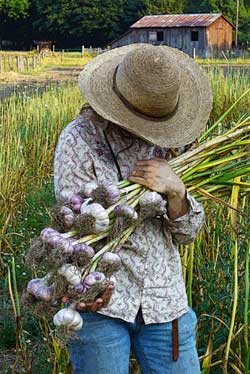
Picture: Patty cradles an armful of healthy Siberian garlic fresh from the field.
What is epigenetics?
 Epigenetics means “above genetics.” It is a system that sits on top of and controls your genetic code or genes. Genes are short pieces of DNA that contain the blueprint for a protein. Your body uses genes as a template to help build and maintain your body. When genes are switched on they produce one or more proteins such as hormones, enzymes, receptors and pretty much every other body component. This process of producing proteins is known as gene expression.
Genes are passed down from your parents. You inherit approximately half of your genetic code from each parent (Mom actually contributes a little bit more than 50 percent). People used to think that genes were stable and that nothing you do would affect them. Now however, we know that genes can be turned off (silenced), turned on (activated), slowed down, or speeded up by using epigenetic controls. This can influence your health or mental processes. Changes caused by this process can even be passed on to your children.
There are two main ways that epigenetics can influence genes; methylation or histone acetylation.
In methylation, a methyl group is added to the genetic code. Methyl groups are CH3 groups found in nutritionally dense food and in nutrients, such as folic acid and vitamin B12. B vitamins act as methyl donors, giving up a methyl group to use in DNA methylation. Methyl groups can attach to genes and either activate or inactivate them.
In histone acetylation, acetyl groups (COCH3) are added to DNA proteins. Histone acetylation increases the accessibility of the genes allowing them to be activated easier. Removing acetyl groups from DNA can inactive or silence genes.
How does eating garlic influence epigenetics?
Garlic may help prevent cancer. In normal cells, tumor suppressor genes detect cancer-like behavior such as uncontrollable cell growth. When these genes sense that the cell is behaving badly they can trigger cell death or stop cell growth.
Cancer cells grow uncontrollable because the tumor suppressor genes that recognize ‘bad behavior’ are turned off or silenced due to too little histone acetylation or by hypermethylation.
Garlic is a double threat to cancer. First, garlic increases histone acetylation in cancer cells which activates tumor suppressor genes. Activated tumor suppressor genes prevent cancer by halting cancer cell growth or triggering the cancer cells to commit suicide. Second, garlic prevents hypermethylation, the process by which cancer cells turn off tumor suppressor genes. 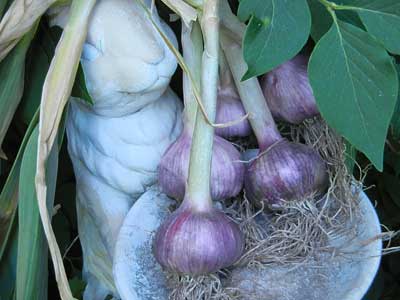
Picture: Shantung Purple garlic bulbs rest on garden rabbit bowl.
A study by Quintero-Fabián et al. (2013) identified how an active component of garlic, alliim (S-allyl cysteine sulfoxide), which is an cardioprotective and neuroprotective antioxidant, changed gene expression in fat cells (adipocytes). Adding alliim to the fat cells upregulated genes involved in immune response and downregulated genes related to cancer.
In addition, adding alliim prevented the fat cells from increasing expression of pro-inflammatory genes. This means that alliim decreased the inflammation commonly associated with excessive fat cells, enhanced immune functioning (which may help prevent cancers from forming), and inhibited pathways that promoted cancer formation.
Excessive inflammation is a major risk factor for metabolic disorders such as diabetes, central obesity, abnormal blood lipids and high blood pressure. Garlic has been shown to reduce the risk of various metabolic disorders.
Garlic compounds reduce ovarian cancer cell growth (Xu et al. 2018) by preventing hypermethylation. Cancer cells use hypermethylation (or excessive methylation) to shut off tumor suppressor genes. Xu et al. 2018 reported that in cell culture, S-allylcysteine (SAC), a garlic compound, inhibited proliferation of cancer cells by inhibiting several methods of hypermethylation.
The biochemistry behind garlic and cancer prevention
Quick science bite: Garlic contains organosulfur compounds which give cloves their characteristic odor and health benefits. Foods rich in organosulfur compounds increase histone acetylation by inhibiting histone deacetylases, metabolites which remove acetylation from DNA (Nian et al. 2009). Histone acetylation triggers tumor suppressing genes which may decrease your chance of getting cancer. Eating garlic and other alliums have been shown to decrease the risk of cancer (Fleischauer et al. 2001, El-Bayoumy et al. 2006, Milner 2006, Myzak and Dashwood 2006, Liu et al. 2007, Millen et al. 2007,Pittler and Ernst 2007, Sener et al. 2007, Nagini 2008 ).
Mechanism: Dietary garlic organosulfur compounds; including Alliin, Allicin, S-allyl mercaptocysteine (SAMC), S-allylcysteine (SAC), diallyl disulfide (DADS), diallyl sulfide (DAS), and diallyl trisulfide (DATS); are metabolized to form allyl mercaptan (AM), allyl methyl sulfide, and methyl mercaptan. AM inhibits histone deacetylase (HDAC) (Nian et al. 2008). HDACs remove the acetylation from DNA, which silences certain genes.
Cancer cells have poor or inappropriate patterns of histone acetylation. HDAC inhibitors can correct this problem by activating epigenetically-silenced genes in cancer cells. This halts cancer cell growth or trigger cancer cell death.
Research shows that cancer cells treated with garlic organosulfur compounds diallyl disulfide (DADS) and S allyl mercaptocysteine (SAMC) showed increased histone acetlyation (Lea et al. 2001, Lea et al. 2002, Druesne et al. 2004). The metabolic conversion of organosulfur compounds to HDAC inhibitors may contribute to garlic’s ability to protect against cancer (Milner 2006, Wargovich 2006).
In addition, SAC can prevent hypermethylation, a mechanism used by cancer cells to turn off or silence genes that prevent cancers. SAC does this by decreasing global DNA methylation levels, DNA methyltransferase (DNMT) activity and protein levels, and messenger RNA in a dose-dependent manner. DNMT is an enzyme that helps add the methyl group to the DNA strand.
Take home message: Research shows that eating garlic can help protect against cancer.
References:
- Druesne N, Pagniez A, Mayeur C, Thomas M, Cherbuy C, Duée PH, Martel P, Chaumontet C. Diallyl disulfide (DADS) increases histone acetylation and p21waf1/cip1 expression in human colon tumor cell lines. Carcinogenesis 2004;25:1227–1236. Pubmed. Full text.
- El-Bayoumy K, Sinha R, Pinto JT, Rivlin RS. Cancer chemoprevention by garlic and garlic-containing sulfur and selenium compounds. J Nutr 2006;136:864S–869S. Pubmed. Full text.
- Fleischauer AT, Arab L. Garlic and cancer: a critical review of the epidemiologic literature. J Nutr. 2001;13:1032S–1040S. Pubmed. Full text.
- Liu CT, Sheen LY, Lii CK. Does garlic have a role as an antidiabetic agent? Mol Nutr Food Res 2007;51:1353–1364. Pubmed.
- Millen AE, Subar AF, Graubard BI, Peters U, Hayes RB, Weissfeld JL, Yokochi LA, Ziegler RG. Fruit and vegetable intake and prevalence of colorectal adenoma in a cancer screening trial. Am J Clin Nutr 2007;86:1754–1764. Pubmed. Full text.
- Milner JA. Preclinical perspectives on garlic and cancer. J Nutr 2006;136:827S–831S. Pubmed. Full text.
- Myzak MC, Dashwood RH. Histone deacetylases as targets for dietary cancer preventive agents: lessons learned with butyrate, diallyl disulfide, and sulforaphane. Curr Drug Targets 2006;7:443–452. Pubmed.
- Nagini S. Cancer chemoprevention by garlic and its organosulfur compounds-panacea or promise? Anticancer Agents Med Chem 2008;8:313–321. Pubmed.
- Nian H, Delage B, Pinto JT, Dashwood RH. Allyl mercaptan, a garlic-derived organosulfur compound, inhibits histone deacetylase and enhances Sp3 binding on the P21WAF1 promoter. Carcinogenesis. 2008; 29:1816-1824. Pubmed. Full text.
- Nian H, Delage B, Ho E, Dashwood RH. Modulation of Histone Deacetylase Activity by Dietary Isothiocyanates and Allyl Sulfides: Studies with Sulforaphane and Garlic Organosulfur Compounds. Environ Mol Mutagen. 2009;50:213–221. Pubmed. Full text.
- Pittler MH, Ernst E. Clinical effectiveness of garlic (Allium sativum). Mol Nutr Food Res 2007;51:1382–1385. Pubmed.
- Quintero-Fabián S, Ortuño-Sahagún D, Vázquez-Carrera M, López-Roa RI. Alliin, a garlic (Allium sativum) compound, prevents LPS-induced inflammation in 3T3-L1 adipocytes. Mediators Inflamm. 2013;2013:381815. Pubmed. doi: 10.1155/2013/381815 (full text)
- Sener G, Sakarcan A, Yegen BC. Role of garlic in the prevention of ischemia-reperfusion injury. Mol Nutr Food Res 2007;51:1345–1352. Pubmed.
- Wargovich MJ. Diallylsulfide and allylmethylsulfide are uniquely effective among organosulfur compounds in inhibiting CYP2E1 protein in animal models. J Nutr 2006;136:832S–834S. Pubmed. Full text.
- Xu Y, Su D, Zhu L, Zhang S, Ma S, Wu K, Yuan Q, Lin N. S-allylcysteine suppresses ovarian cancer cell proliferation by DNA methylation through DNMT1. Journal of ovarian research, 2018;11:39. doi: 10.1186/s13048-018-0412-1