Southern Garlic Grower’s Guide
From Texas and Oklahoma to the California Coast: Garlic Gardening in the Arid Desert or Humid Deep South: Revised for 2017!
Even if you are an experienced garlic grower you may want to check out our new secret Southern growing tips for larger garlic bulbs! (expanded with more detailed advice on chilling seed stock)
By Susan Fluegel, PHD
This is a guide to how to grow gorgeous garlic in the South. We used to garden and live in Houston, Texas so we personally know the challenges you can face in the deep humid South! Thank you to all of our fellow garlic growers who have generously let us know what garlic varieties worked for them!
Check Out These Fun Topics:
Why is garlic growing a challenge in the South?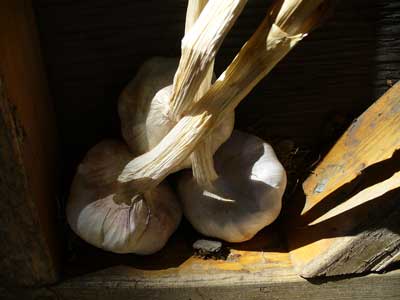
Picture: Large Lorz Italian garlic bulbs; these tasty softnecks are ideal for Southern growing.
What secret garlic growing tip should every Southern garlic grower know for bigger garlic bulbs?
Does hardneck garlic need vernalization in the South (exposed to cold)?
Should I refrigerate garlic cloves before planting?
What garlic varieties should I try in the South?
Southern garlic growing tips
Why is garlic growing a challenge in the South?
Most garlic has evolved to thrive in northern climates. It breezes through frigid temperatures, Canadian snows and spring frosts that would make most plants beg for mercy. I've seen garlic standing tall surrounded by snow and ice. When our naked garlic bulbs were stored in an unheated building, not even protected by soil, it survived several weeks of sustained temperatures in the -15 to 20ºF.
Sadly, there is a downside to this cold weather hardiness, many garlic varieties need winter's chill to form summer's bulb. Of the two main garlic types, hardneck garlic and softneck garlic, hardneck garlic normally requires cold exposure to make bulbs while softneck garlic are more tolerant of warm winters.
Garlic develops bulbs (heads) due to a combination of daylength, temperature, and vernalization (winter cold exposure). Many hardneck garlic begin bulbing when daylength is over 13 hours AND air temperature is above 68-70ºF AND soil temperature is over 60ºF. When these factors are out of synch, or not what the garlic considers ideal, garlic bulbs do not develop very well.
For example, if the weather gets too hot too soon in the spring, garlic will mature too quickly and have small bulbs. Some garlic can even de-vernalize after cold treatment if temperatures get too hot or too dry in the spring! If this happens, the garlic will only develop a small bulb. To prevent this you may need a longer vernalization time.
You want garlic that will produce in your warmer climate. Your goal is to try to have a large garlic plant with lots of leaves and a good root system by the time bulbing begins. Selecting garlic varieties that are more adaptable to the South and practicing proper cultural habits will help ensure growing success.
What two secret garlic growing tips should every Southern garlic grower know for bigger garlic bulbs?
1) If you want your garlic to grow big bulbs you need to delay two things; the start of bulbing and the end of bulb growth (known as bulb maturation). Larger plants produce larger bulbs. You want your garlic plant to be tall with lots of big healthy leaves before it starts developing a bulb. This way it will have plenty of energy to devote to clove growing. Likewise, once the plant starts developing a huge scrumptious garlic you want it to grow that garlic for as long as possible before it starts to mature. That bulb can double in size in a week so every day counts!
As mentioned above, garlic plants decide when to bulb and mature based on a combination of daylength, air temperature, soil temperature, and vernalization. You can't change daylength but you can influence temperature, especially soil temperature. Garlic begins bulbing when soil temperatures reach around 60ºF and begins bulb maturation (which halts bulb growth) when soil temperatures reach 90-91ºF.
Your #1 goal is to keep that soil temperature as cool as possible for as long as possible. This will delay the bulb forming and maturing process. Remember; even one week of cooler soil temperatures can result in a significantly larger garlic bulb. Tactics that work to chill soil include mulching, strategic use of shade, and encouraging deep root growth. I discuss all these techniques below.
2) If you live in a warm climate you need to use vernalization (refrigeration) to fool your allium bulb into thinking it is living it up in the frigid north. Those of you in the extreme South may need to use as much as 10-12 weeks of refrigeration before planting. Check here for more on how to use vernalization to trick Mother Nature.
Use mulching to keep soil cool: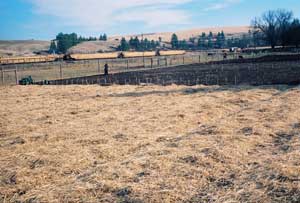
Picture: Garlic beds mulched with straw.
- A loose mulch over soil will keep ground and roots cooler during the day. The deeper the mulch the better it will work.
- Light colored mulches like fluffy yellow straw (or even newspaper) deflect heat better than dark colored mulches. Non porous mulches like straw or wood chips are also poor conductors of heat (which keeps the heat away from garlic roots).
- One study on tree planting found that a wood bark mulch kept soil significantly cooler throughout the summer season, especially in the spring and early summer (Greenly and Rakow 1995). The mulched soil (25 cm mulch) was 5.9ºC (10.6ºF) cooler at the end of June and 2.4ºC (4.3ºF) cooler at the end of July than the unmulched soil. The deeper the mulch the cooler the soil.
- Sinkevičienė et al. (2009) reported that all the organic mulches tested; wheat straw, peat, sawdust, and grass; significantly decreased soil temperatures. The straw mulch decreased the soil temperature the most when compared to no mulch.
- Likewise, Liu et al. (2014) reported a significant soil temperature decrease in citrus trees mulched with straw when compared to trees with no mulch.
Use shade to chill soil:
- Try direct shade on the soil and at the base of the plant (even if the shade is not on plant's leaves). This can be done using a short board placed so it will shade the plant's roots and base during the hottest part of the day. You could also place shade cloth to protect the soil from direct sunlight.
- Another method is to locate your garlic garden so that it receives shade during the hottest part of the day. Most of our field is in shade starting around two o'clock. Our hottest part of the day is from 2-5 pm. Our garlic always matured later than other garlic growers in the area.
Encourage roots to reach deeper with proper watering and clove planting:
Water deeply but infrequently to encourage deep root growth. Soil is cooler deeper in the ground. Also, plant garlic cloves 4-6 inches deep so roots are deeper from the beginning.
Does hardneck garlic need vernalization (cold exposure)?
Hardneck garlic requires vernalization (exposed to a period of cold temperatures) before or after planting. Cold temperatures stimulate garlic to sprout and develop a bulb. For best results, the garlic clove needs to be exposed to 40-50ºF outdoors for 6-12 weeks during the winter to stimulate bulb formation.
The warmer the area you live in the longer you need to refrigerate your planting stock. Vernalization occurs normally when planting in cold areas. If you live in a warm winter area you may need to help Mother Nature along a little bit.
Important Southern Grower Tip:
I heard from a Florida panhandle garlic grower who cold treats his garlic in a paper bag in his refrigerator (not freezer, every year we hear from at least one person who has froze their seed stock). He found that a vernalization time of 10-12 weeks in the refrigerator totally prevents garlic bulbs from breaking vernalization, also known as de-vernalization (when bulbs de-vernalize they develop much smaller bulbs).
Previously, he had tried a shorter vernalization period of 6-8 weeks and this worked only on colder years. The garlic would break vernalization on hotter or drier winter. The longer vernalization period of 10-12 weeks has even enabled him to grow hardneck garlic successfully! The Florida panhandle is a challenging area to grow garlic due to the rapidly switching ocean warm air currents in the winter.
The Science Behind Chilling Your Seed Stock:
Gardening research has shown that you will grow bigger garlic bulbs in the South if your seed stock has some cold exposure. Researchers treated garlic with a 40 day vernalization period in a wet subtropical climate (Southern Brazil) (de Resende et al. 2011). Seed bulbs were vernalized in a cold chamber at 4°C (40ºF) and 80% humidity. The garlic cloves that were cold treated had increased vegetative growth, higher commercial production, and better marketable attributes than the cloves that were not cold treated. Garlic that received the cold treatment for 30 days didn't grow as well as the garlic receiving 40 days of chilling.
When you buy bulbs from a Northern grower, usually the bulbs have received some cold treatment (it gets pretty chilly in the garlic barn at night). If you live in a really warm region where winter temperatures stay above 40-45ºF you should inquire how much cold treatment your seed garlic has received. If your garlic comes with root buds you can be sure it was exposed to some cooler weather (hardneck garlic does not develop root buds until it is exposed to temperatures around or below 45-50ºF and a bit of moisture). If needed, supplement the existing cold treatment with a little time in the refrigerator.
Serious commercial growers store their seed garlic in a cold room at 50ºF and 55-65% humidity. For home growers several extension sites recommend refrigerating cloves for 2-6 weeks before planting. After hearing from Southern growers, I would recommend cooling garlic heads for at least 6-8 weeks to plant in a moderately warm climate and for 10-12 weeks to plant in a tropical climate. Ask your garlic provider to mail you the bulbs as early as possible and pop those garlics in the refrigerator. Only try this if you live someplace where winter temperatures won’t get at or below 40-45ºF for at least 6-8 weeks.
To check out your average winter temperatures go to an internet weather service like msn weather and click on averages. There will be a chart showing the average highs and lows for a year in your area. Remember that soil temperatures will likely be a bit lower than air temperatures. You can also ask your local extension agent about your average winter temperatures and soil temperatures.
CAUTION: Garlic can rot or mold if it is kept too moist so make sure to keep your cloves or bulbs dry in the refrigerator (check on them often and never store in plastic or airtight containers). Don’t freeze the garlic; put it in the warmer part of the refrigerator. We have never used this technique but some Southern extension services and growers recommend it. We would love to hear about your experiences with vernalization via refrigerator.
Why do plants need vernalization? Many plants use vernalization to coordinate their growth and flowering to their environment. Vernalization processes are different in different plant families (Ream et al. 2012). Kim and Sung (2014) found that exposure to long-term cold temperatures represses floral genes that inhibit flowering in many plants. The ability to flower is due to epigenetic changes in the plant's genes. In other cases, genes are turned on (expressed) due to exposure to cold periods. These genes seem to induce flowering (Ream et al. 2014).
Other changes may occur during vernalization. Recent research shows that garlic responds to cold conditioning or vernalization with increased synthesis of phenolic compounds and anthocyanins due to increased activity (expression) of genes for phenolic metabolism (Dufoo-Hurtado et al. 2013).
What garlic varieties should I try in the South?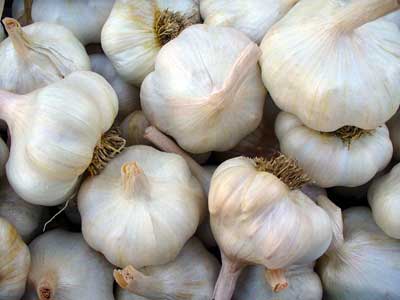
Picture: Thermadrone softneck garlic bulbs grow well in warmer climates. These garlics multiple rapidly and are very tasty!
To be safe, garlic growers in the deep South should always grow at least one softneck garlic like Lorz Italian or Thermadrone. You want to have one garlic that is fairly sure to do well!
Garlic growing is a little more unpredictable in warm climates. Some varieties require more vernalization than others. Softnecks, like Thermadrone, don’t need much at all which is why they are preferred in Southern climates. It is worthwhile trying a garlic variety more than one year.
Garlic varieties that have grown well for Southern growers:
- Thermadrone: Buttery French softneck.
- Lorz Italian: a bold flavored softneck that loves hot summers!
- Marbled Purple Stripes like Siberian or Bogatyr (we have had lots of love for Siberian): Siberian is delicately flavored while Bogatyr has a deep true garlic flavor. These two varieties have large bulbs even when the heat soars skyward. In 2015-2016 they produced great even in the midst of a summer with temperatures breaking 100 year records.
- Georgian Crystal (most years): a medium great flavored garlic.
- Romanian Red (only in years when winters are cooler): a hot savory garlic. We suspect another Porcelain garlic, Parvin, may be a better hot garlic to try.
Many of our Southern customers have reported success with these varieties. However, if you are in the deep South, a hot and humid coastal climate or a really hot microclimate you may want to go with a softneck such as Thermadrone or Lorz Italian as your main garlic and just experiment with the hardnecks. In years when the summer is extremely hot very early in the spring hardnecks will not do well (unless treated with 10-12 weeks vernalization). Please take your climate into account.
Other varieties reported to do well in the South: Turbans such as Tzan and Shantung Purple as well as Creoles. Warning: I have received reports from two Southern growers who had poor results and ended up with no harvest with Tzan! Another grower reported poor results with Shantung Purple.
Take your microclimate into account:
If you have cold nights and hotter days (desert, mountains and hills) hardneck garlic grows better. Cold nighttime temperatures keep the soil cooler and promote longer bulb growth.
Those with mild nights and hot days (coastal areas) will have a harder time growing hardneck garlic and may need to grow softneck garlics. Make sure to plant your hardneck garlic just before the coldest part of your year to receive the most benefits.
For those in planting zone 9-10 your safest bet is softnecks like Thermadrone or Lorz Italian (although it is fun to experiment with other varieties such as Siberian).
General Southern Growing Tips:
Choose a Good Garden Site:
Your main goal in the South is to provide needed sun while making sure garlic roots stay cool. (Please see the section on Southern garlic growing tips). If you are in an area with burning hot noon to afternoon sun, try to pick a garden site that receives sun in the morning and shade during the hottest part of the day so soil stays cooler. If you have to use a very sunny spot add shade.
Cooler soil prevents garlic from maturing too fast (the faster garlic mature the smaller the bulb). Once soil reaches 90-91ºF garlic will mature quickly and bulb growth will halt.
Garlic prefers full or partial sun. You don't need full sun for good garlic. Our garlic grows fine in partial shade (it is shaded in the afternoon) and we are in an area with fairly low sun intensity. We can't even grow most sweet corn well here because there isn't enough built up heat during the day.
Soil:
If your soil is that special Southern variety known as ‘gumbo’ (basically clay/concrete) or if your soils are soggy or underwater most of the year, you may want to plant garlic in raised beds with more arable soil. Garlic needs loose well drained soil with lots of organic matter. It can very easily rot in poorly drained heavy soil. Most of our customer's problems with growing garlic are due to cloves rotting in poorly drained soil.
Garlic likes well drained loamy or silty loam soil with a pH of between 6-8. If soil is too alkaline it can encourage disease and insect problems.
You can easily amend sandy or clay soil by adding organic matter. Garlic also likes a well balanced fertilizer when it is actively growing (in the South, that will be in fall or winter). You should stop fertilizing when garlic scapes appear. See a lot more on soil amendment and fertilizing on our page on how to grow organic garlic.
Planting:
Lucky Southern growers can plant up until December. Most commercial garlic growers try to get their garlic in by October or November since the longer winter results in bigger bulbs. The garlic will come up and grow during the winter. Southerners will be able to harvest their garlic a month or more before Northern growers!
Plant cloves 4-6 inches deep and make sure to place the top upward. The top of the clove is the pointed end, and if it is not facing up the bulbs will be deformed. For pictures of proper planting technique see our how to grow organic garlic page or check out our Garlic Grower's Guide. Some Southern garlic sites recommend planting only 2 inches deep but in our experience deeper planting results in much larger bulbs. The soil will be much cooler further down in the ground. Cooler soil helps prevent bulbs from maturing too soon. Garlic cloves should be spaced 4-8 inches apart. We space ours 6 inches apart in the row; with rows 8 inches apart.
Mulching:
Unless your soils are very wet, mulch with straw or compost to keep the ground cold longer. We have found that straw or hay can cause stem rot in moist or humid climates. In this case, mulch with compost instead. Compost may actually help prevent stem rot. Or mulch with compost in the winter and add fresh dry clean straw over the top of the compost in the spring when it gets hotter. Light colored mulch will help deflect heat and keep the ground cooler.
Hot soil forces the garlic to mature faster and results in smaller bulbs. Mulching can keep soil cooler (Sinkevičienė et al. 2009). A thick mulch is essential on sandy soils to help retain soil moisture. Straw mulch increased yield and marketability in no-till garlic grown in Virginia (Bretsch et al. 2005). Note: we don't recommend no-till with garlic since the same study found a 31-44% bulb loss due to no-till!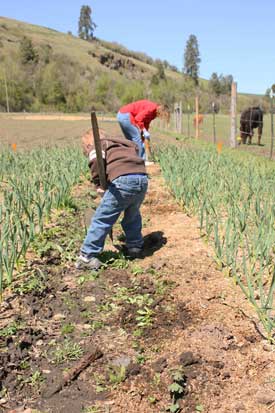
Picture: Nate attacks a weed in the garlic field. Note the dying weeds behind him. He is an enthusiastic worker and likes to help!
Weeding:
Garlic competes poorly with weeds. Weeds can reduce yield by over 50%. Too many weeds = very small garlic. Weed grow rapidly in the south and can be a challenge when growing without herbicides. See here for tips on how to control weeds naturally.
Heavy mulching helps control weeds by preventing weeds from sprouting. Training your children to weed when they are young can also reduce the weed problem! Just make sure they can tell garlic plants from weeds before you turn them loose with the hoe.
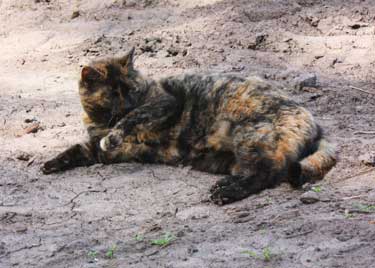 Picture: Our short tailed cat, Hissy, takes a break from her busy day of controlling voles and sunning herself to lick a paw. Hissy's mom was a good mouser too.
Other Pests (Voles, Gophers and Mice):
Voles, gophers and mice will eat garlic under the ground! This can result in ragged stands of garlic in the spring or even no garlic coming up at all. If you have a large vole, gopher or mouse population you may need to control it. This can be done using traps or a few motivated cats. Our cats, Baby and Hissy, work hard to keep our garlic field clear of any vermin.
Update: Sadly both Baby and Hissy, our best gopher catcher, have passed away. They are greatly missed. We now have a new cat that moved in who is named Old Man. He is a gorgeous fluff ball and a fine mouser and we are not sure why anyone would abandon such a promising feline to the wilds of the country (he had obviously been an indoor pet before). However, their loss is our gain. Old Man has teamed up with a feral female feline called Slinky to catch gophers in pairs.
Scaping:
Garlic produces false seedheads or scapes before it starts to bulb. Scapes can be left on or removed. Removing scapes may result in bigger garlic bulbs since the plant then devotes all its energy to the bulb. Many people consider scapes a delicacy and they can be eaten. Scapes have a mild garlic flavor.
Harvest:
Harvest hardneck garlic when about half the leaves have turned brown. For us in Idaho, this is around late July or August. For Southern growers it will likely be in May, June or July. Turbans in particular are really early! Garlic will stop growing and mature when the soil temperature reaches 90 F. If you have a really hot, early summer the garlic will be ready to harvest sooner (and will have smaller bulbs). You need to keep an eye on it until you figure out when it is likely to be ready. Harvest softneck garlic when the lower few leaves are starting to turn brown.
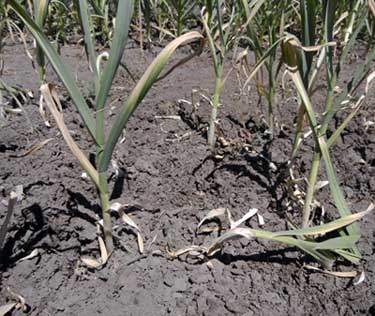 Picture: Thermadrone softneck garlic ready to harvest (other plants in the bed have already been dug up). Note that only the bottom 2-3 leaves are brown and that some garlic plants are starting to fall over. Once the plant falls over no more bulb development occurs and it should be dug up. Pulling on fallen over garlic plants will usually break the bulb off below ground. For more pictures of garlic ready to harvest see Garlic Questions.
When harvesting, carefully dig plants. Garlic plants can even be pulled if the soil is loose enough. Usually we shovel near the plant to loosen the dirt and than carefully pull. Remove loose soil from bulbs and roots but leave the stalks on. If you live in a high humidity area, trim off the dirty roots leaving about ¼ inch roots on the bulb. Excess wet roots can prevent drying or cause rot. Removing the excess root and dirt will help prevent mold or rot on the garlic bulb. Handle bulbs carefully to avoid bruising your crop. Garlic is delicate.
IMPORTANT: Garlic can sunburn. When harvesting garlic bulbs make sure to take them out of the sunlight and put in a shaded area.
Southern Growers Need to be Careful about Curing:
Curing garlic will take 4-6 weeks. Bulbs and stalks can be hung or placed on racks in a shady cooler area. Spread bulbs out so that they can dry. Normally roots, leaves and 'stalk' are left on the garlic until after the bulb is cured. This reduces bulb rotting in storage (prevents pathogens from entering cut stem of bulb). Make sure there is air movement around the bulbs. Use fans if needed to move moisture. This is especially necessary in hot humid climates to prevent the garlic from rotting.
Try to dry the garlic fairly quickly. Big bulbs need extra care and Thermadrone and other softnecks can be picky about curing! We used to have problems with curing Thermadrone until we figured out the proper drying technique.
Softneck Garlic Bulb Curing Technique: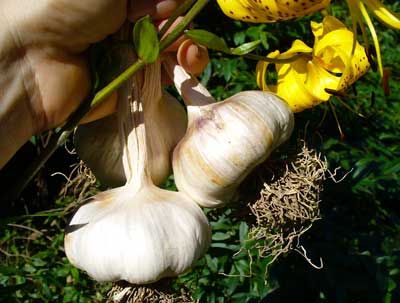
Picture: Lorz Italian softneck garlic bulbs in the process of curing. Note how roots and neck of garlic are dried and shriveled but bulbs are still plump. This is normal.
- The key is to dry huge bulbs quickly.
- Remove all mud/dirt from roots.
- Dry garlic in cool shady area.
- Do not space curing garlic too close together. Really spread bulbs out so that all sides are exposed to air movement (we place them on top of ventilated nursery trays).
- If it is humid or wet use a fan to dry. Aim fan directly at garlic.
- If bulbs are not curing fast enough, you may even need to cut off the roots from big juicy softneck bulbs (roots absorb moisture from the air). Several times we have had to cut off the stalks from Thermadrone because it was not curing fast enough. Keep an eye on it, you don't want to lose your crop!
- How can you tell if you need to get drastic on your garlic softnecks? If roots have not shriveled within a few days to a week or if you are noticing a slightly sour smell like fermenting vegetation (or silage) it means that conditions are poor for drying and plants are not curing properly. If you don't increase drying speed bulbs may look fine BUT have an increased tendency to rot or to mold inside the bulb! They also do very poorly in storage.
Curing removes the green garlic taste and adds a more complex flavor to the bulb. When garlic is dried it can be removed from the stalk, roots trimmed to about ¼ inch and the bulb cleaned carefully by removing the dirt on the outer wrappers.
You can also remove a few outer wrappers to make the garlic look prettier but since this dries out the bulbs faster I recommend you do it directly before selling or giving away your gourmet garlic. Be careful, if your garlic was harvested a little late it may not have any extra wrappers to remove.
References:
- Bratsch T, Morse R, Shen Z, Benson B, Dept. of Horticulture, Virginia Tech. No-till Organic Culture of Garlic Utilizing Different Cover Crop Residues and Straw Mulch for Over-wintering Protection, Under Two Seasonal Levels of Organic Nitrogen. Virginia Vegetable, Small Fruit and Specialty Crops – November-December 2005. Full text.
- de Resende JTV, Morales RGF, Resende FV, Faria MV, de Souza RJ, Marchese A. Garlic vernalization and planting dates in Guarapuava. Hortic Bras. 2011;29 no.2 Brasília doi: 10.1590/S0102-05362011000200010 (full text)
- Dufoo-Hurtado MD, Zavala-Gutiérrez KG, Cao CM, Cisneros-Zevallos L, Guevara-González RG, Torres-Pacheco I, Vázquez-Barrios ME, Rivera-Pastrana DM, Mercado-Silva EM. Low-temperature conditioning of "seed" cloves enhances the expression of phenolic metabolism related genes and anthocyanin content in 'Coreano' garlic (Allium sativum) during plant development. J Agric Food Chem. 2013;61:10439-46. Pubmed. doi: 10.1021/jf403019t
- Greenly KM, Rakow DA. The effect of wood mulch type and depth on weed and tree growth and certain soil parameters. Journal of Arboriculture 1995;21:225-232. Full text.
- Kim DH, Sung S. Genetic and epigenetic mechanisms underlying vernalization. Arabidopsis Book. 2014;12:e0171. Pubmed. doi: 10.1199/tab.0171 Full text.
- Liu Y, Wang J, Liu D, Li Z, Zhang G, Tao Y, Xie J, Pan J, Chen F. Straw Mulching Reduces the Harmful Effects of Extreme Hydrological and Temperature Conditions in Citrus Orchards. PLOS. 2014; doi: 10.1371/journal.pone.0087094 (full text)
- Ream TS, Woods DP, Amasino RM. The molecular basis of vernalization in different plant groups. Cold Spring Harb Symp Quant Biol. 2012;77:105-15. Pubmed. doi: 10.1101/sqb.2013.77.014449
- Ream TS, Woods DP, Schwartz CJ, Sanabria CP, Mahoy JA, Walters EM, Kaeppler HF, Amasino RM. Interaction of photoperiod and vernalization determines flowering time of Brachypodium distachyon. Plant Physiol. 2014;164:694-709. Pubmed. doi: 10.1104/pp.113.232678 (full text)
- Sinkevičienė A, Jodaugienė D, Pupalienė R and Urbonienė M. The influence of organic mulches on soil properties and crop yield. Agronomy Research 2009:7:485–491. Full text.